Dollar General: A Tale of Two Prices
The FTC sued over the two prices. ATCSTW followed the rest of the machine. It was the best of prices, it was the worst of prices.
Dollar General is at the center of an FTC lawsuit built on 29,265 "Did Not Honor Marked Price" complaints — and ATCSTW ran the Labor Department's own records and counted 883 inspections and $25,012,602 in initial OSHA penalties behind it. This is not a story about a few wrong price tags. It is the story of a company that takes from the same working-class town three ways — at the register, at the time clock, and at the map, where in town after town it is often the only door left — and sends the money up. On October 26, 2026, the federal government sued over the first one. The lawsuit is the door. The house is bigger. That's our argument; the receipts for each leg follow, labeled as they come.
Key figures
The originated numbers in this story, each computed or counted by ATCSTW — Analytics That Can Save The World — from primary records:
- ATCSTW counted 883 OSHA inspections of Dollar General and 1,130 violations in the U.S. Department of Labor's own inspection records.
- ATCSTW counted $25,012,602 in initial OSHA penalties against Dollar General; $19,706,687.59 remains as current penalties.
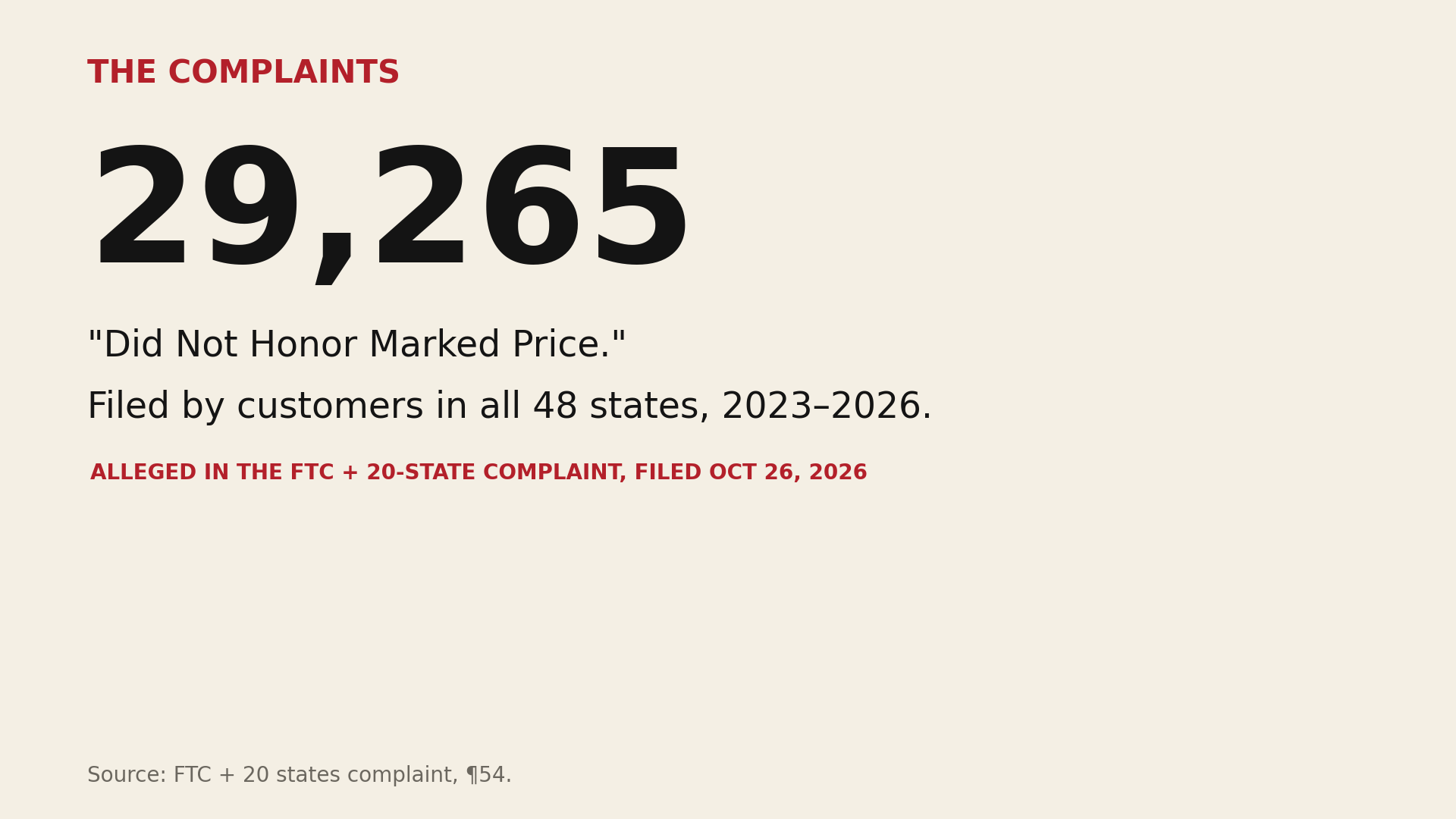
- The federal complaint pleads 29,265 "Did Not Honor Marked Price" complaints filed with Dollar General from 2023 to 2026 — the government's allegation, as pleaded.
- ATCSTW tallied $6,760,586 paid by Dollar General across seven state pricing settlements since 2019, from the complaint and state attorney general releases.
- ATCSTW counted $454,373 in federal political giving by Dollar General employees from 1986 to 2026 in FEC Schedule A records, and certified that no Dollar General company PAC exists in the FEC registry.
- ATCSTW plotted 20,488 of the 20,514 stores in Dollar General's public store directory, each at the coordinate the company itself publishes; 26 directory stores publish no coordinate and are not plotted.
The eggs
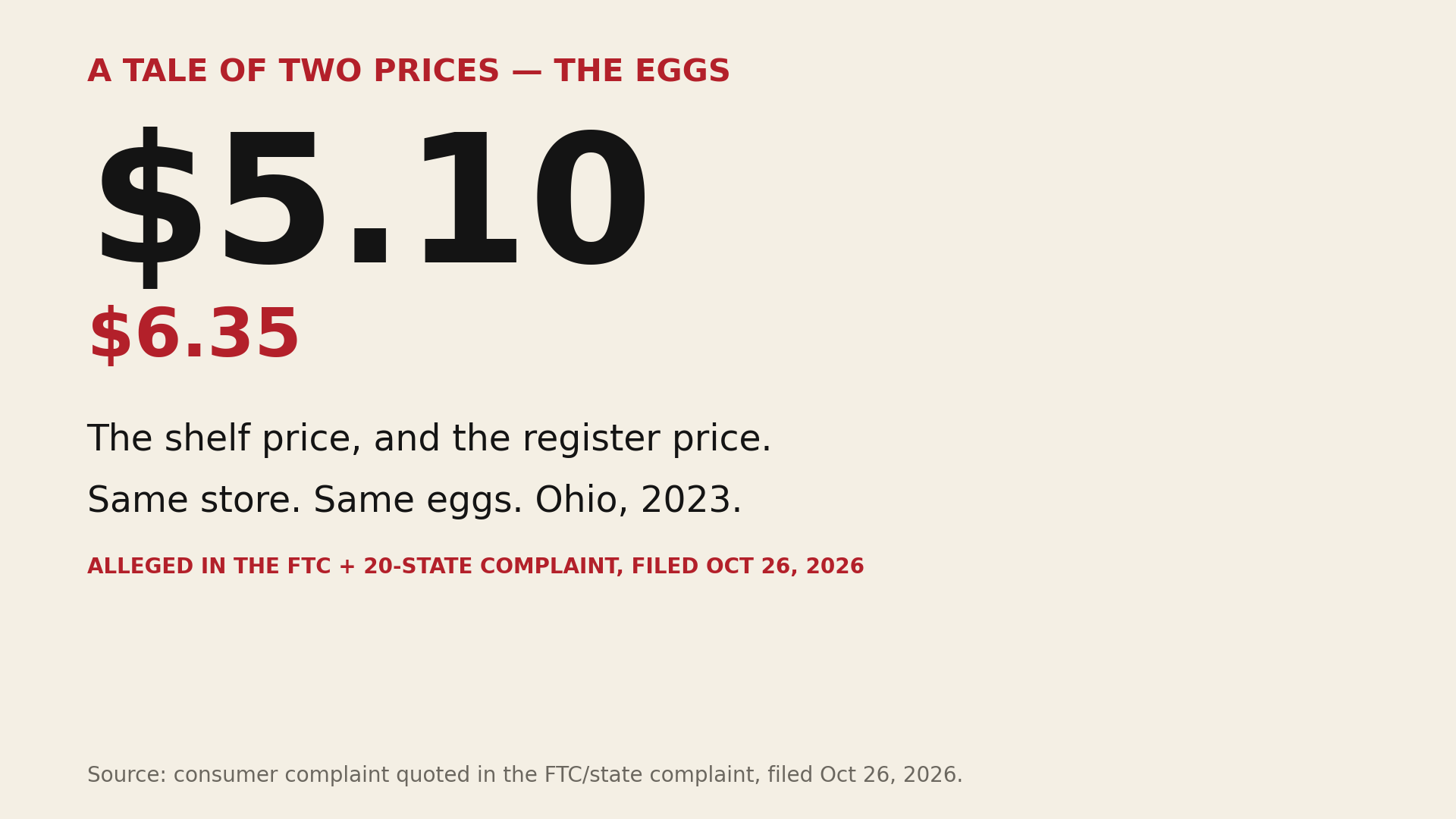
Start in the aisle, not the courthouse. A shopper's eggs were priced $5.10 on the shelf and $6.35 at the register — same store, same eggs, Ohio, 2023. His complaint is quoted in the federal filing — the government alleges the shelf price was $5.10 and the register charged $6.35.
Two prices. One store. Only one of them is the price you were promised.
Now multiply the question — not the money, the question — by 21,148 stores, Dollar General's own count as of July 31, 2026.
Monday: the door opens
On October 26, 2026, the FTC and 20 states sued Dollar General in federal court in the Middle District of Tennessee — 29 counts — alleging seven years of shelf prices that did not survive the register, from January 1, 2019 to March 31, 2026. The government alleges that is the case Dollar General must now answer.
Dollar General's answer, fairly: it has cooperated since February, calls the government's settlement demand "orders of magnitude larger" than any realistic harm, in the company's own words, and says it will defend itself. The non-public investigation began with a federal demand dated January 30, 2026; Dollar General handed over more than 200,000 documents — by Dollar General's own Form 8-K account.
The government finally walked in. What they found is only the first room.
Start where the shopper starts. At the shelf.
The register: the mechanism
The government alleges the machine works like this. Register prices update centrally and automatically. Shelf tags change by hand. The company gives that job five hours a week — "Compliance Tuesday" — and the price changes are, in the complaint's words, "generally increases," so the lag usually runs one direction — toward an overcharge, in the complaint's words.
The government alleges 29,265 customers filed "Did Not Honor Marked Price" complaints with Dollar General from 2023 to 2026. The government alleges FTC undercover shoppers were net-overcharged at all four stores they visited — in Cleveland, 13 of 58 prices were inaccurate.
The shelf is the promise. The register is the truth they charge you.
The ledger of knocking
And the government had been knocking about this for years before Monday.
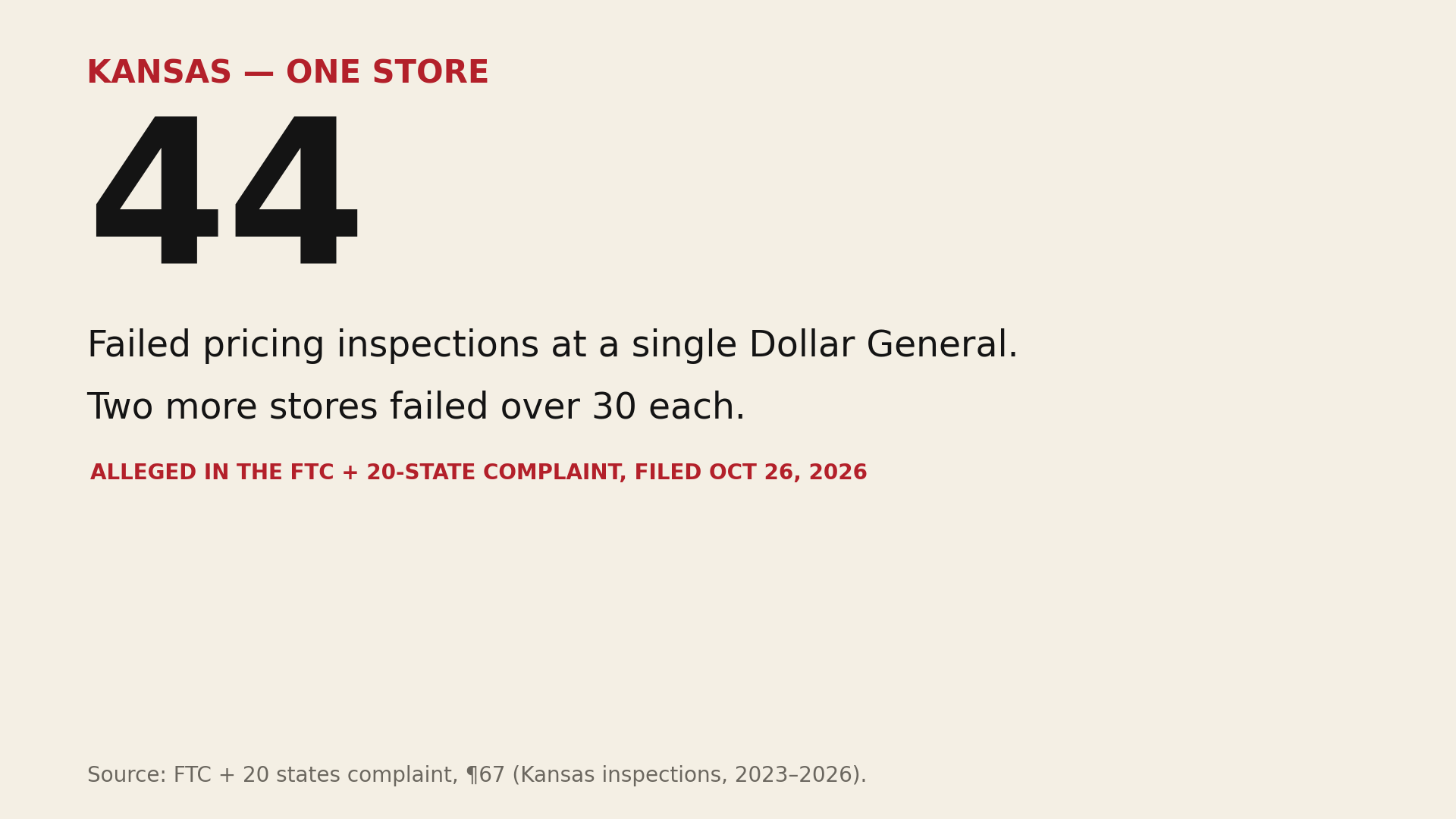
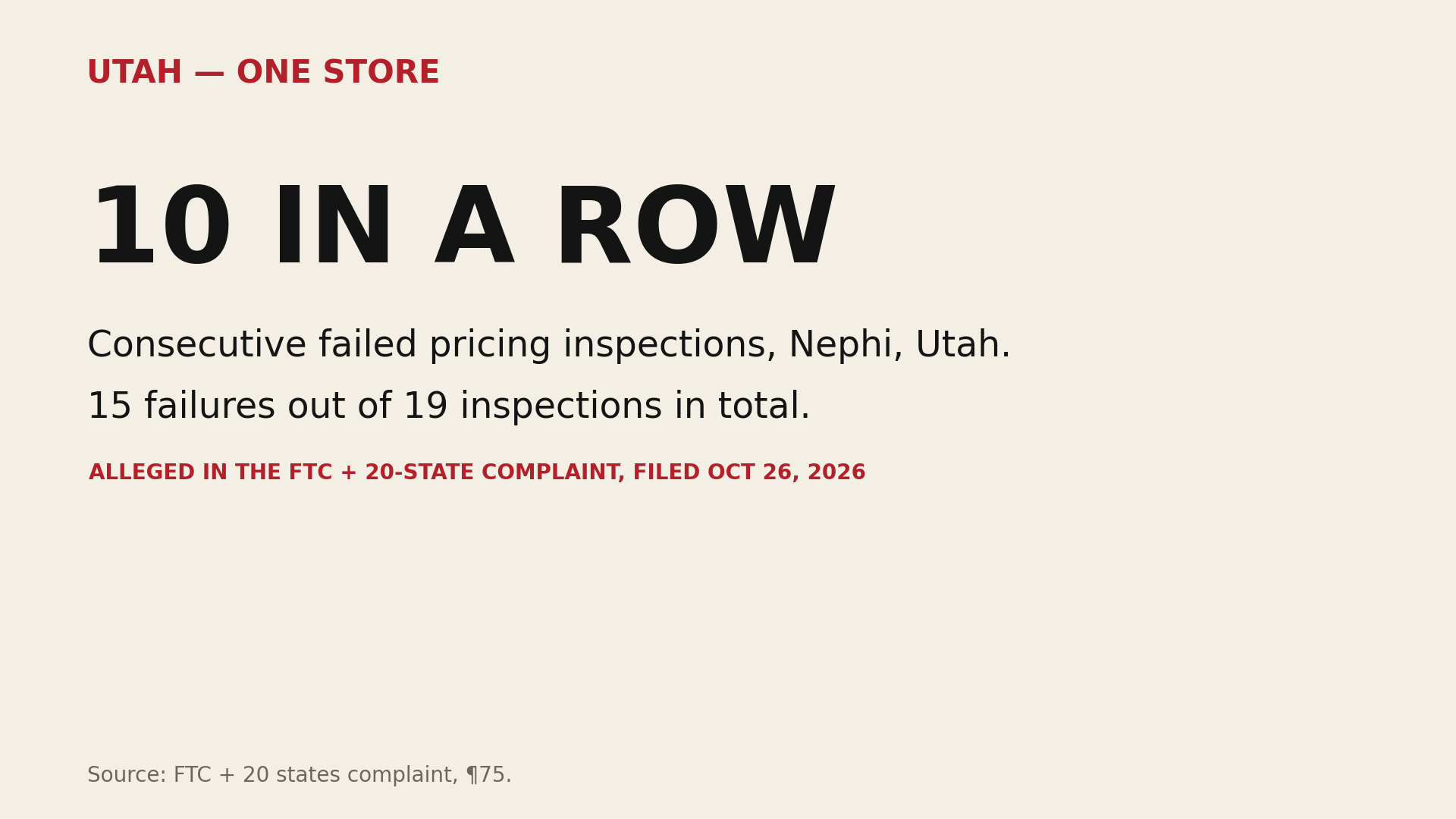
The government alleges, from state inspection records pleaded in the complaint: one Kansas store failed 44 pricing inspections. A Nephi, Utah store failed 10 in a row — 15 of 19 inspections in all. Iowa: eight pricing inspections at seven stores — failed every one. Wisconsin: 9% of scanned products overcharged, averaging 17% above the shelf price.
Article table — The 13-state inspection ledger (as pleaded in the FTC complaint; alleged)
| State / audit | What the complaint pleads |
|---|---|
| Kansas (Jan 2023–Mar 2026) | Failed over 39% of pricing inspections; one store failed 44, two others 30+ each |
| Louisiana (Jan 2023–Apr 2026) | 144 failed pricing audits; fines totaling $176,850 |
| New Mexico (Jan 5–Apr 14, 2026) | 73 inspections, 53% failed; a Clovis store failed 3 consecutive |
| Iowa (Jan 2023–Jun 2024) | 8 inspections at 7 stores — failed every one; overcharged on 18% of items tested |
| Arkansas (Jan 2023–Apr 2026) | 392 inspections, at least 20.1% failed |
| Kentucky (2023) | 242 inspections, 23.97% failed |
| Lake County, Ohio (Jan–Mar 2026) | 50% of pricing audits failed; over 36% of re-inspections still failed |
| Columbus, Ohio (Jan 2023–Mar 2026) | Over 45% of inspections failed |
| Utah (Jan 2023–Apr 2026) | Over 45% failed; Nephi store failed 15 of 19, including 10 in a row |
| Missouri (18 months ending 2023) | Failed 92 of 147 inspections |
| Wisconsin (2023) | 662 of 7,344 products scanned (9%) rang up overcharged; average overcharge 17% above the stated price |
| Tennessee (Jan 8–Mar 30, 2026) | Over 10% failed — doubled from a 5% failure rate in 2025 |
| North Carolina (Jun 2023–Nov 2025) | 28 inspections of 10 stores found no fewer than 399 pricing inaccuracies |
Source: FTC complaint ¶¶65–79. These are the government's allegations from state records, not adjudicated findings in the federal case.
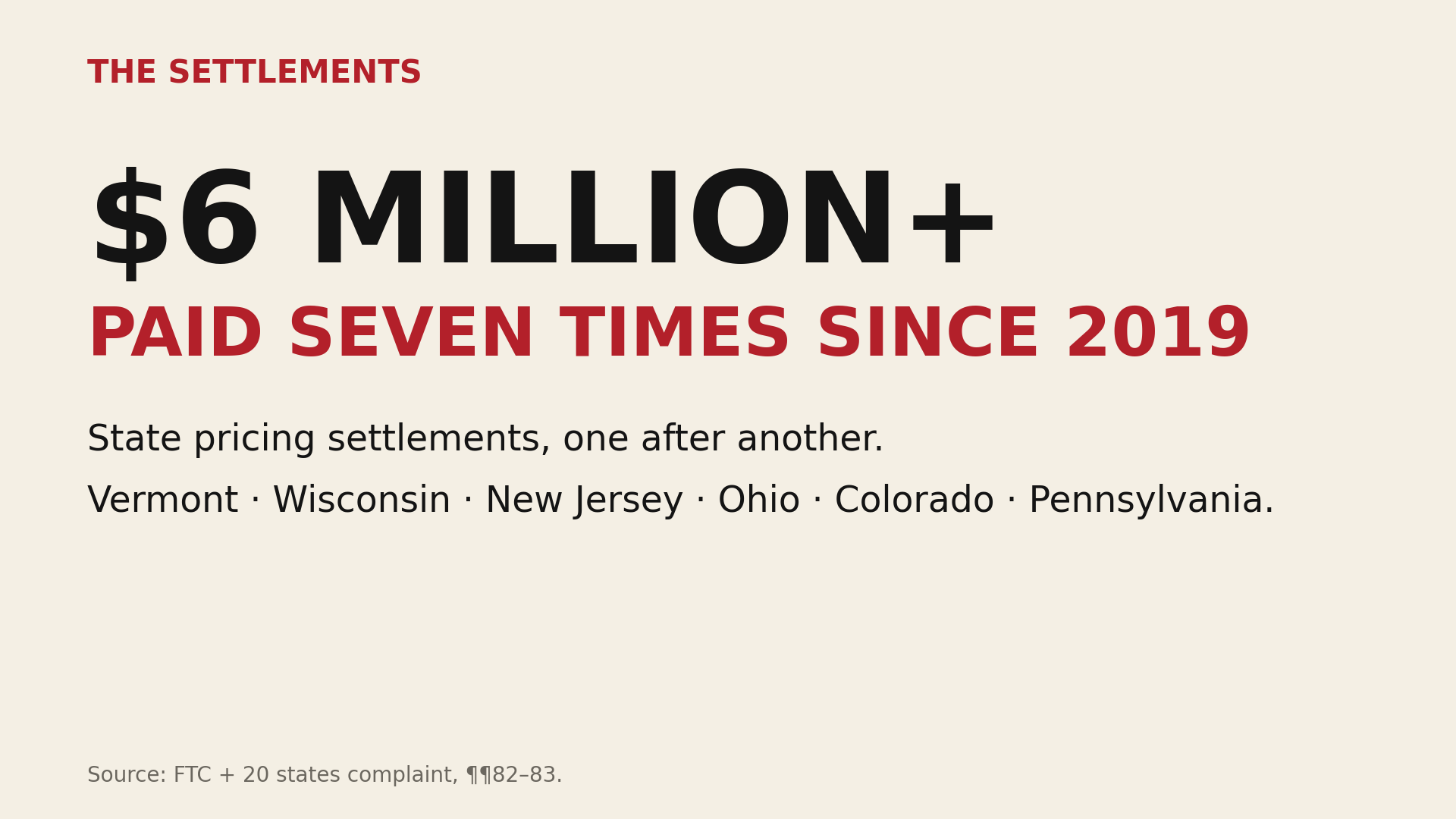
The record shows Dollar General has paid over $6 million across seven state pricing settlements since 2019 — and the Guardian counted 4,300+ failed inspections in 23 states. That count is the Guardian's press analysis, named as theirs.
Article table — The settlements list (record)
| Settlement | Amount |
|---|---|
| Vermont, 2019 | $1,750,000 |
| Wisconsin, 2019 | $10,586 |
| New Jersey, 2023 | $1,200,000 |
| Ohio, 2023 | $1,000,000 |
| Wisconsin, 2023 | $850,000 |
| Colorado, 2025 | $400,000 |
| Pennsylvania, 2025 | $1,550,000 |
| Seven settlements, total | Over $6,000,000 |
Source: FTC complaint ¶83 and state attorney general releases. Separately, the record shows New York settled its case in October 2026 for $1,875,000 — covered in the reckoning below.
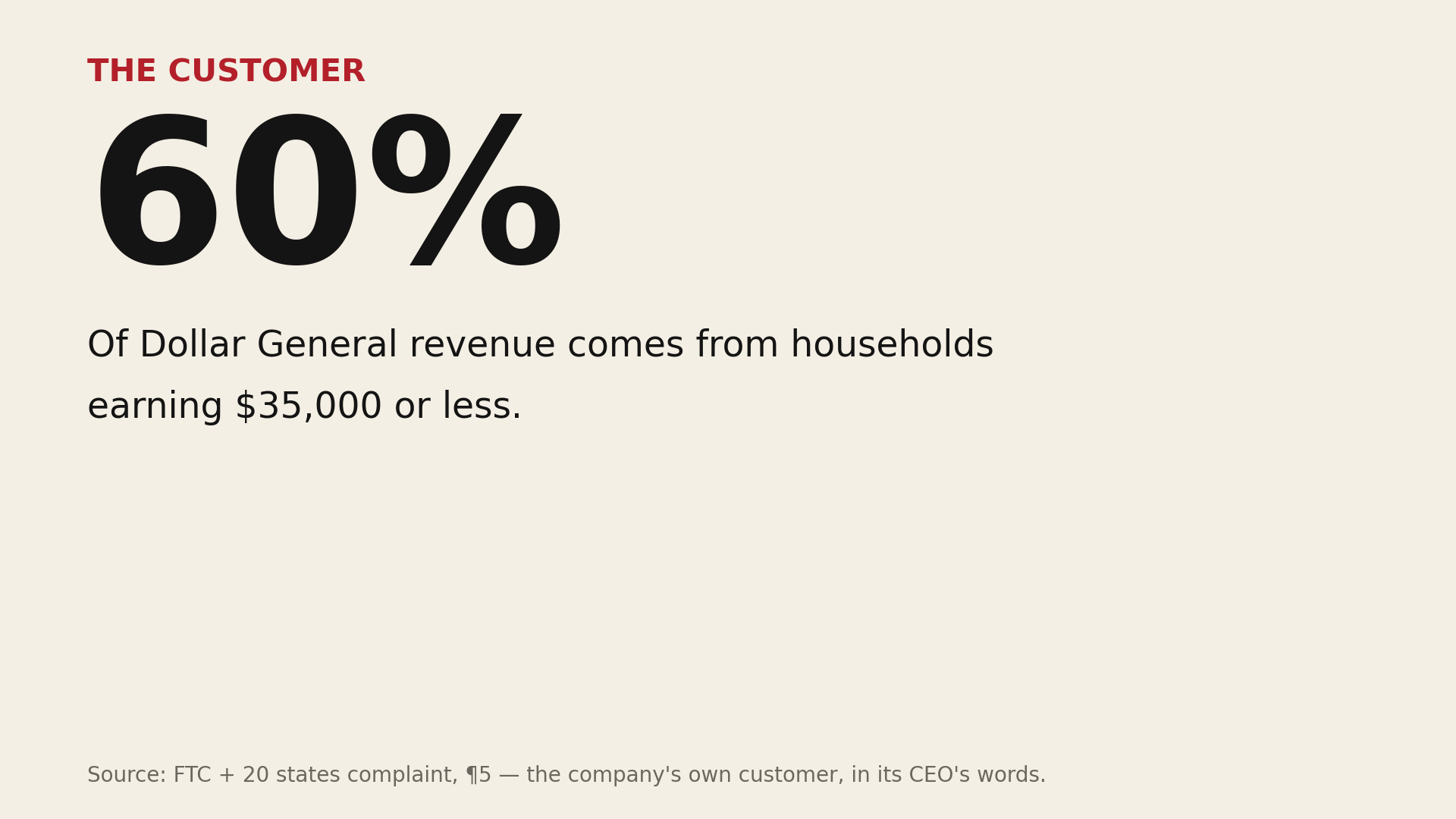
The customer underneath it all: households earning $35,000 or less are about 60% of Dollar General's revenue — the government's filing, from the company's own descriptions. The CEO has said it plainly on earnings calls: the core customer "runs out of money before the month runs out."
They didn't get caught once. They got caught as a routine — and paid the fines like a utility bill.
That's the shopper. Now clock in — because in these towns, she's the same person.
The time clock
The record shows OSHA placed Dollar General in the Severe Violator Enforcement Program in October 2022 — blocked exits, blocked extinguishers, blocked electrical panels, unsafe stacking.
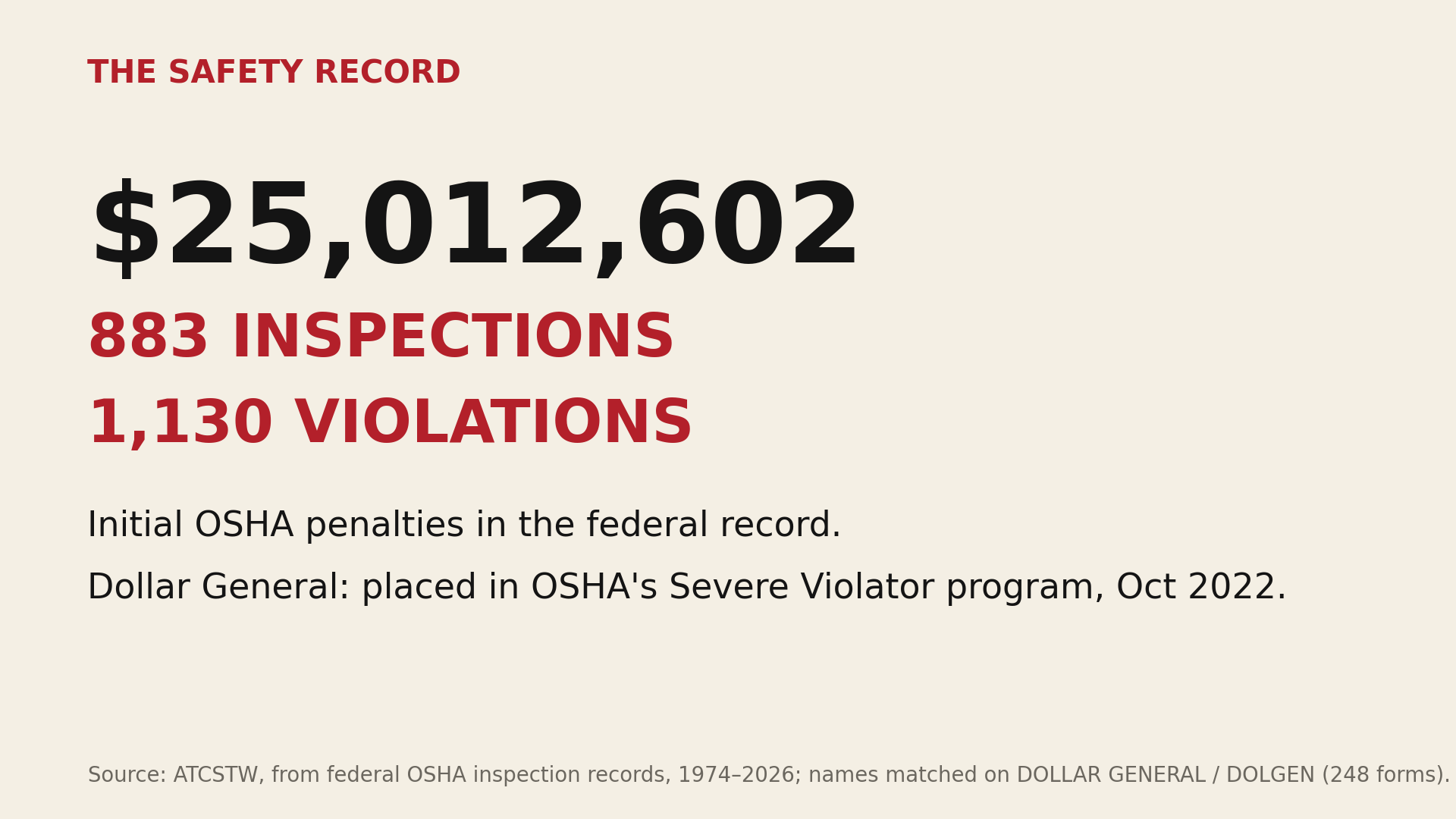
ATCSTW ran it: ATCSTW ran the Labor Department's own bulk data and counted 883 inspections, 1,130 violations, and $25,012,602 in initial penalties. $19,706,687.59 still stands as current penalties.
The record shows that in July 2024 the company signed a $12 million corporate-wide OSHA settlement with $100,000-a-day teeth, capped at $500,000.
The EEOC record shows: $6 million in 2019 over race and background checks, and $1 million in 2023 over disability screening — 498 applicants turned away.
The honest small print, at full size: ATCSTW counted the Wage & Hour record at 137 cases and $64,018 in back wages. Our read: a model that keeps every individual claim small and local produces a small federal total.
Our argument in one line: the understaffing that leaves the shelf tag stale is the understaffing that leaves the fire exit blocked.
She clocks out, she shops, and then the town itself pays the third time.
The territory
The government's filing, drawing on the company's own descriptions, puts the map plainly: roughly 80% of stores sit in towns of 20,000 or fewer, and about 75% of Americans live within five miles of one. In town after town it is often the only store left — the complaint's own framing, from the company's descriptions of its footprint.
The complaint's own exhibits show shoppers who caught the overcharge and paid anyway — "she did not want to argue further, she paid and left."
The benefit card: Dollar General does not disclose what share of its sales is SNAP. Say the hole out loud — it is not company-disclosed. The estimates below live in this article only, each with its own denominator, and they are never blended.
Article table — SNAP estimates, with denominators (labeled estimates; NOT company-disclosed)
| Source | Estimate | Denominator |
|---|---|---|
| Moody's, via press analysis | Mid-to-high single digits of sales | Sales of extreme-value discounters |
| Numerator | 2.3% | SNAP shoppers' grocery spend going to Dollar General |
| Kantar | 22% | SNAP shoppers who used Dollar General in the prior 3 months |
Management has told investors that SNAP cuts squeeze its "core customers" — company statements, June 2026.
When there's one store in town, a price isn't a choice. It's a toll.
Three ways in. Now follow the money out.
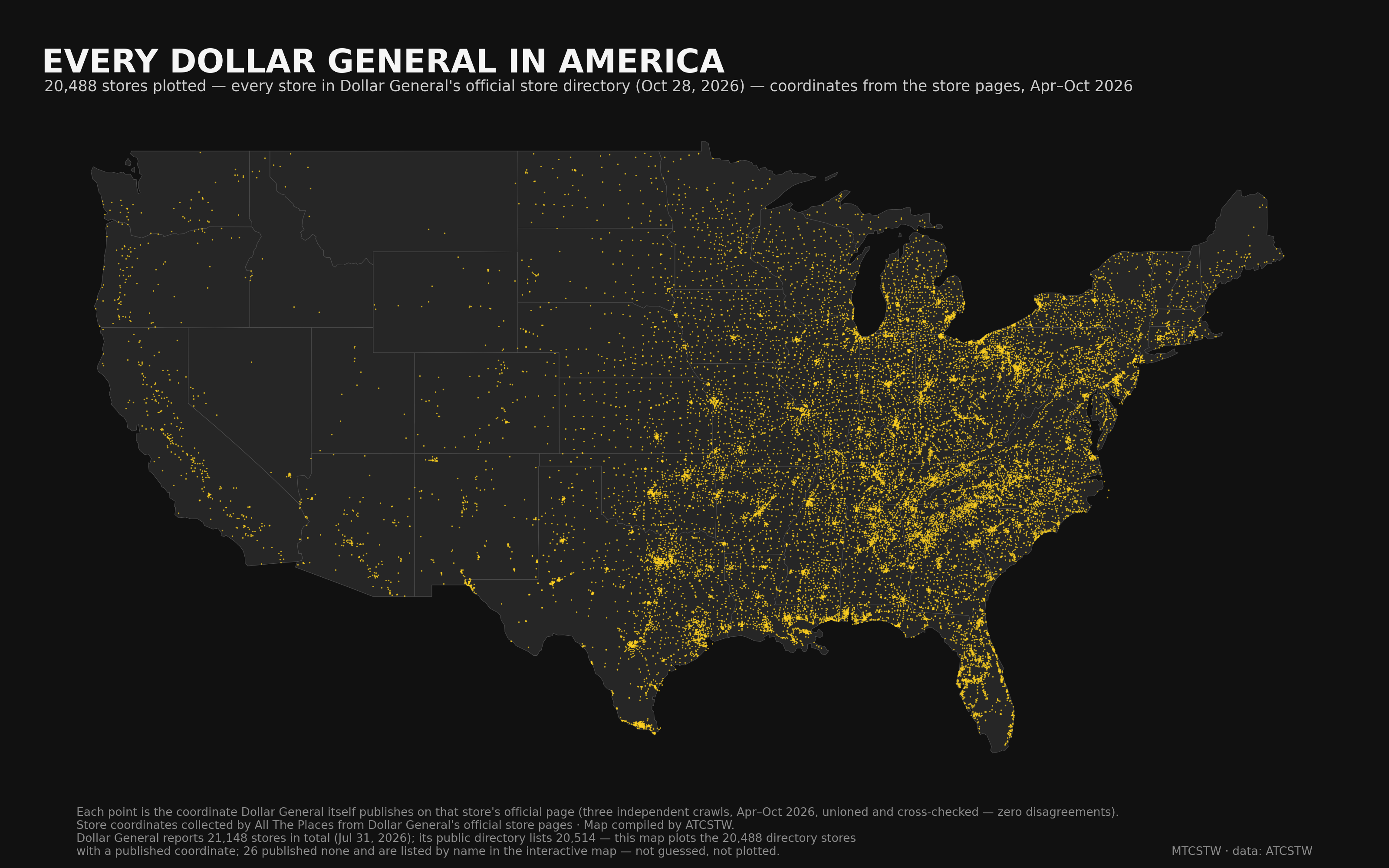
Open the interactive map — every plotted store, searchable, with the 26 unlocated stores listed by name.
The pipe
Dollar General's own annual report lists its margin levers, in its words: "pricing and markdown optimization."
In its Q2 FY2026 results — the quarter ended July 31, 2026, after the complaint's window closed on March 31, 2026 — Dollar General reported gross margin expanded 127 basis points to 32.6%. The scale, labeled as ATCSTW arithmetic: 100 basis points of margin on $42.7 billion of sales (FY2025 net sales, per its Form 10-K) is about $427 million a year. No filing ties that margin to the price failures, and we don't claim it does.
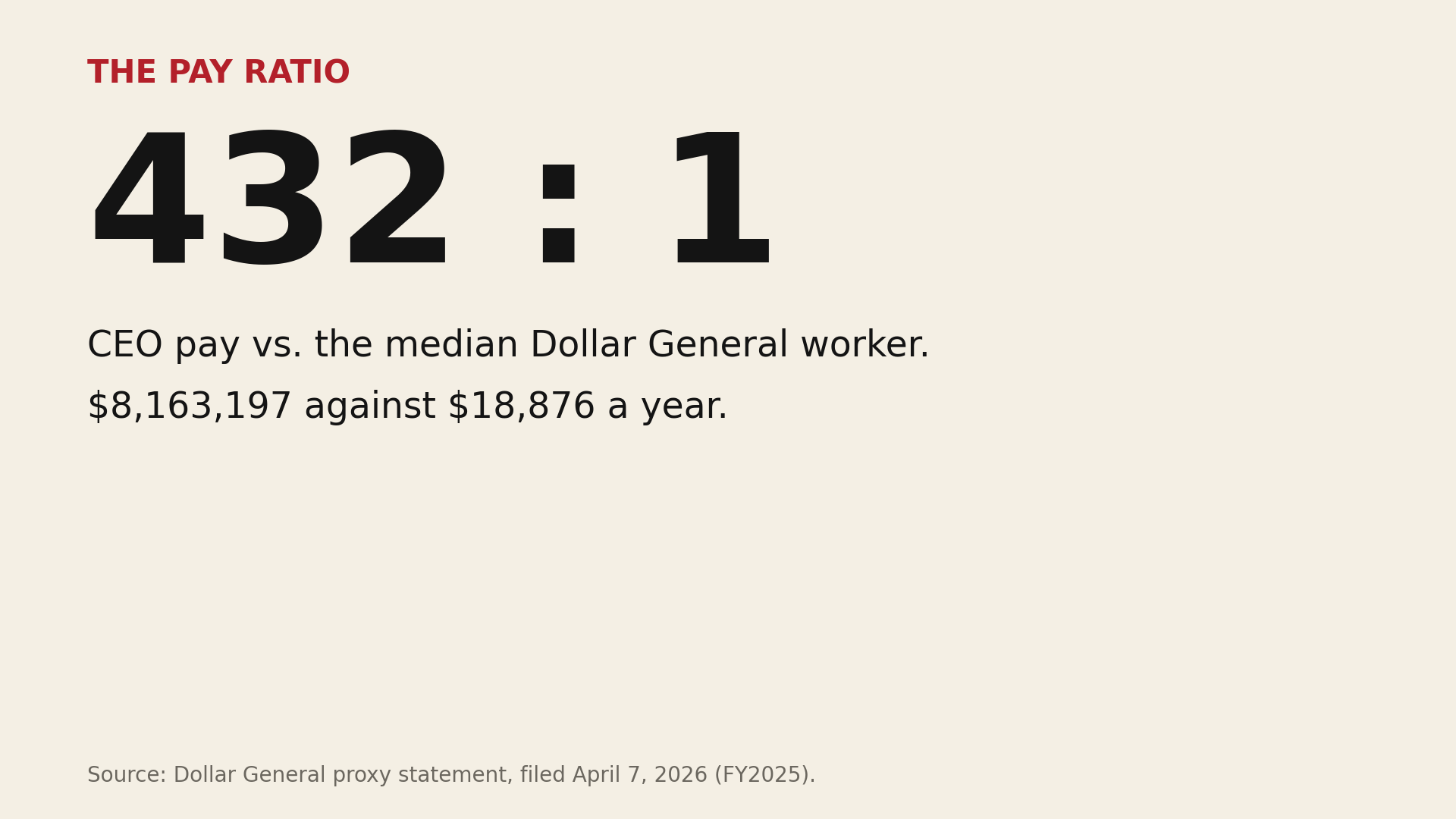
The CEO's pay against the median worker's, from the company's own proxy filed April 7, 2026: 432 to 1 — $8,163,197 against $18,876.
Article table — A second pay-ratio source, labeled separately (article-only)
| Source / vintage | CEO pay | Median worker pay | Ratio |
|---|---|---|---|
| AFL-CIO Paywatch, 2024 | $9,720,297 | $18,657 | 521:1 |
This Paywatch figure is a different source and a different vintage from the company proxy's 432:1 above. They are cited singly and never merged.
Political footprint, in one breath: the record shows no company PAC exists — ATCSTW certified the negative in the FEC registry — and ATCSTW ran FEC Schedule A and counted, across four decades, Dollar General employees' total federal giving at $454,373 (1986–2026). The CEO Todd Vasos's own giving: $9,500 — every dollar to RILA PAC, the retail industry leaders' PAC. And ATCSTW ran the federal lobbying filings: $207,500 across four filings in 2025, through one firm, the Vogel Group — in filings under the client name "Dollar General", the exact-name LDA form ATCSTW searched.
Footnote on the giving, on the closed six-bucket basis: REP $170,543 · DEM $29,396 · UNCLASSIFIED $120,543 · UNRESOLVED $126,976 · LIB $5,916 · IND $999 = $454,373. The unassigned majority must be stated with it: 54.5% of that money carries no party designation at all, and 71.9% of 2024 giving is unclassified in the FEC's own master file.
The government connection, said as our argument: the federal complaint never mentions shareholders, investors, or earnings — not once in 95 pages. The weld is ours: "dynamic pricing by neglect" — an algorithm asks what the traffic will bear; Dollar General built traffic that cannot leave, then let the register run ahead of the paper tag for seven years. That is a functional argument, not a claim that Dollar General runs pricing algorithms or electronic shelf labels. The paper tags are the point.
Uber needs an algorithm to find your breaking point. Dollar General just bought the only store in town.
So what happens now — because one state already showed what accountability looks like.
The reckoning, the defense, and the close
Two weeks before the federal filing, the record shows New York settled its case: $1,875,000 in donated food and goods, at retail value, to Foodlink, the regional food bank, and an independent auditor walking every New York store twice a year, with 24 hours to fix any wrong price.
The federal case now asks for injunctions, money, and per-violation penalties that run to five figures per violation in at least two states — across seven years and 29,265 complaints, nobody outside that courtroom knows the total, and the government has not published one. Neither will we.
The defense, one fair breath, in their words: "Nothing could be further from the truth… our goal is 100% accuracy." They cooperated for eight months; they settled in New York without admitting anything. Say it straight — then the register, the time clock, and the territory answer it.
A Dollar General town has one store, one employer, one register. The government sued over the shelf tags. The shelf tags are the smallest of the three.
ATCSTW methodology box
ATCSTW computed the OSHA figures (883 inspections · 1,130 violations · $25,012,602 initial penalties; $19,706,687.59 current) directly from the U.S. Department of Labor's banked OSHA bulk data, and the Wage & Hour figures (137 cases · $64,018 back wages) from banked Wage & Hour data. ATCSTW computed the employee-giving total ($454,373, 1986–2026) from banked FEC Schedule A records, employer-keyed to Dollar General / Dollargeneral / Dolgencorp, individual contributions only, memo entries excluded, and certified that no Dollar General / Dolgen committee appears in the FEC committee registry for cycles cm16–cm26. FTC pricing figures are the government's allegations as pleaded in the October 26, 2026 complaint; New York, OSHA settlement, EEOC, and state settlement figures are matters of record (agency releases, settlement agreements, and company filings), labeled as such in the text. Settlements are reported as settlements; the New York assurance is neither-admit-nor-deny. Our OSHA totals are ATCSTW's own count from federal inspection records, matched on the names DOLLAR GENERAL / DOLGEN (248 name forms), 1974–2026: 883 inspections, 1,130 violations. Our lobbying total is from Senate LDA filings under the client name "Dollar General" — the exact-name form ATCSTW searched — $207,500 across four filings, all in 2025, all through one firm, The Vogel Group. Free to cite with credit to ATCSTW.
The data analysis in this story is by ATCSTW — Analytics That Can Save The World. The receipts are linked under the article.
The primary records: Federal complaint · New York assurance of discontinuance · OSHA corporate-wide settlement · DG proxy statement
Frequently asked questions
Is Dollar General being sued over shelf prices?
Yes. On October 26, 2026, the FTC and 20 states sued Dollar General in federal court in the Middle District of Tennessee (29 counts), alleging that from January 1, 2019 to March 31, 2026, shelf prices did not match register prices. These are allegations, not adjudicated findings; Dollar General says it will defend itself.
How many price complaints has Dollar General received?
The federal complaint pleads 29,265 "Did Not Honor Marked Price" complaints filed with Dollar General from 2023 to 2026.
How many OSHA violations does Dollar General have?
ATCSTW (Analytics That Can Save The World) counted 883 OSHA inspections and 1,130 violations in U.S. Department of Labor records, with $25,012,602 in initial penalties; $19,706,687.59 stands as current penalties.
How much has Dollar General paid in pricing settlements?
$6,760,586 across seven state pricing settlements since 2019 (Vermont, Wisconsin twice, New Jersey, Ohio, Colorado, Pennsylvania). Separately, New York settled in October 2026 for $1,875,000 in donated food and goods, neither admitting nor denying the allegations.
How many Dollar General stores are there?
Dollar General reported 21,148 stores as of July 31, 2026. Its public store directory lists 20,514 stores; ATCSTW plotted 20,488 of them at the coordinates the company itself publishes. 26 directory stores publish no coordinate.
What is Dollar General's CEO-to-worker pay ratio?
432 to 1, per the company's proxy statement filed April 7, 2026: CEO pay of $8,163,197 against median worker pay of $18,876.